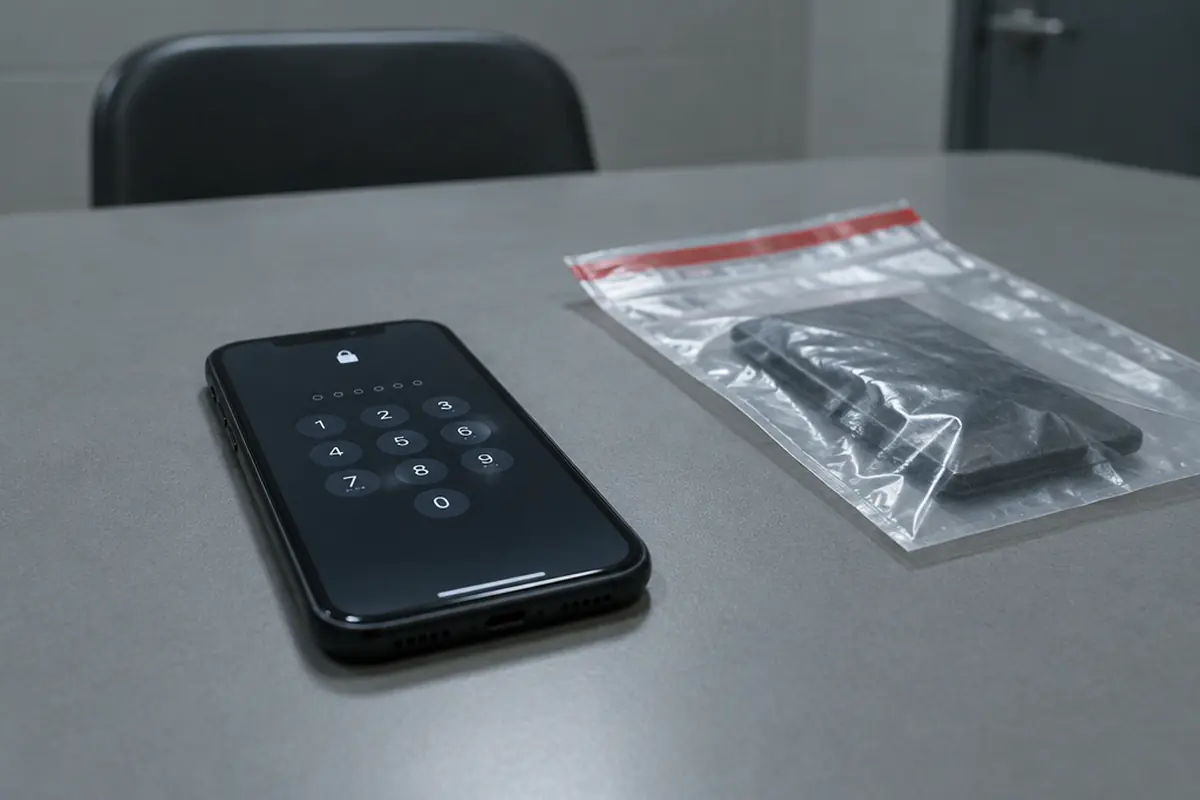
When the police seize a phone, one of the first things they often ask for is the PIN or passcode. Whether you have to give it depends on how you are being asked. A simple request from an officer is different from a formal written notice under the Regulation of Investigatory Powers Act 2000.
In short, you do not usually commit an offence by declining an ordinary request. But if you are served with a formal notice requiring you to disclose the PIN, refusing without a reasonable excuse is a criminal offence in its own right.
Key points
- An ordinary police request for your PIN is not, by itself, a legal requirement.
- A formal notice under section 49 of the Regulation of Investigatory Powers Act 2000 can legally require you to disclose a PIN or password.
- Failing to comply with a section 49 notice can carry up to 2 years in prison, or 5 years in national security or child indecency cases.
- The Scottish appeal court has held that evidence found after a PIN was given during a search can be used, even without legal advice first, in some circumstances.
- If you are arrested, you have the right to speak to a solicitor before being interviewed.
An informal request
Officers often ask for a PIN during a search, at arrest or in custody. That is a request, not a legal requirement. You can decline, and you can ask to speak to a solicitor first. Our police interview solicitors advise people in exactly this situation.
Be aware, though, that if you provide the PIN voluntarily, what is found on the phone can be used as evidence. In McLean v HM Advocate (2023), the Criminal Appeal Court held that a person whose home was being searched under a warrant, and who had not been arrested, did not need to be given access to legal advice before responding to a police request for the PIN of a phone found in the search. The evidence from the phone was allowed.
A formal section 49 notice
Part III of the Regulation of Investigatory Powers Act 2000 applies across the UK, including Scotland. It allows a notice to be served requiring someone to disclose protected information, such as a PIN, password or encryption key, where the police have lawfully obtained the device and the right permission has been given.
A notice must be in writing and must explain what is required and by when. Refusing to comply without a reasonable excuse is an offence under section 53.
| Type of case | Maximum sentence for failing to comply |
|---|---|
| Summary conviction | 6 months in prison or a fine |
| Conviction on indictment, most cases | 2 years in prison |
| Conviction on indictment, national security or child indecency cases | 5 years in prison |
Good to know: Forgetting a PIN can be a defence to a section 53 charge, but the court will look closely at whether that is credible. Take advice before you respond to any notice.
Can the police get into my phone anyway?
Often, yes. Police Scotland can use digital forensic tools to examine many devices without the passcode, although it can take time. They can also seek information from service providers and cloud accounts using other legal powers. Refusing a PIN does not always stop the evidence being obtained.
What should I do?
- Ask what is being requested Is it an informal request, or a formal written notice? You are entitled to know.
- Ask for a solicitor If you are under arrest, you have the right to legal advice before interview, and it is free in custody.
- Do not delete or wipe anything Destroying data after you know of an investigation can lead to further charges.
- Do not ignore a notice If you receive a section 49 notice, take advice immediately. The deadline matters.
Phones are central evidence in many cases, including cyber crime, indecent images, drugs and harassment allegations. Our guide on what happens after an arrest in Glasgow explains the custody process.
Asked for your PIN or served with a notice? Get urgent advice from our criminal defence team. Your first hour is free.
Book a free consultationFrequently asked questions
Is refusing to give my PIN an admission of guilt?
No. Declining an informal request is not an offence or an admission. Failing to comply with a formal section 49 notice is a separate offence.
Do I have to unlock my phone with my face or fingerprint?
The law in this area is developing. Ask for a solicitor before agreeing to unlock a device in any way.
How long can the police keep my phone?
The police can keep a seized device while it is needed for the investigation or as evidence. A solicitor can ask for its return once it is no longer needed.
Can my employer's phone be taken?
Yes. Work devices can be seized in the same way, and your employer may be asked for access.