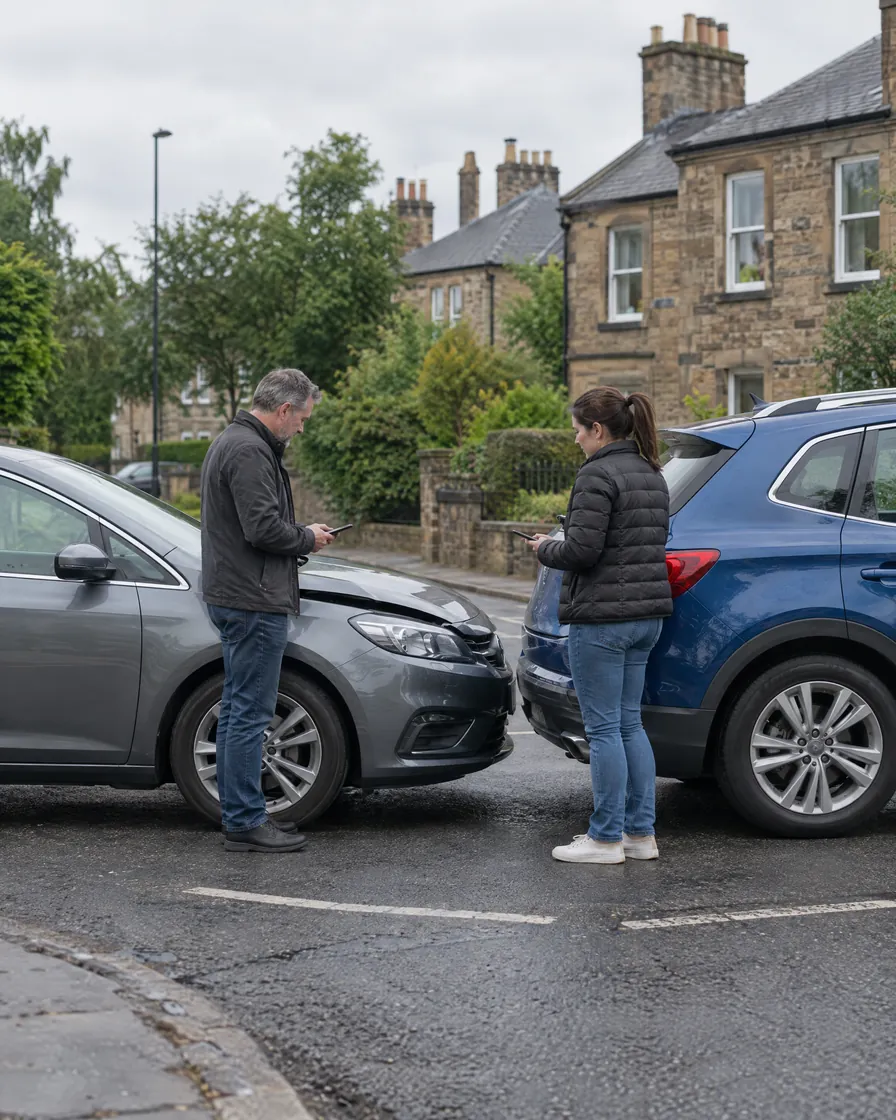
Careless driving, also called driving without due care and attention, is one of the most common charges after a road traffic collision in Scotland. It covers a wide range of driving, from a momentary lapse at a junction to more serious misjudgements. The penalties range from 3 penalty points to a driving ban.
Our careless driving solicitors in Glasgow advise drivers on the evidence, possible defences and the best way to present their case to the procurator fiscal or the court.
Key points
- Careless driving is driving that falls below the standard of a competent and careful driver, under section 3 of the Road Traffic Act 1988.
- Inconsiderate driving, such as driving through a puddle to splash pedestrians, is a related offence under the same section.
- The court can impose 3 to 9 penalty points or a discretionary ban, and a fine.
- For lower-level cases, the police may offer a fixed penalty of £100 and 3 points instead of prosecution.
What counts as careless driving?
The test is objective: did your driving fall below the standard expected of a competent and careful driver? Examples include:
- pulling out of a junction into the path of another vehicle;
- driving too close to the vehicle in front;
- being distracted, for example by a phone, sat nav or passengers;
- failing to stop at a red light or give way;
- losing control in poor conditions.
Careless driving is less serious than dangerous driving, which involves driving far below the standard expected. Read our guide to the difference between careless and dangerous driving.
Careless driving penalties
| Offence | Penalty |
|---|---|
| Careless or inconsiderate driving (CD10, CD20, CD30) | 3 to 9 points or a discretionary ban, and a fine |
| Fixed penalty offered by the police | £100 fine and 3 points |
| Causing serious injury by careless driving (CD33) | 3 to 11 points, an obligatory ban and possible imprisonment |
| Causing death by careless driving (CD80) | 3 to 11 points, an obligatory ban and possible imprisonment |
Can a careless driving charge be defended?
Many careless driving cases depend on what witnesses say about a few seconds of driving, and on the physical evidence at the scene. Scots law generally requires corroboration, meaning evidence from more than one source, before someone can be convicted. Possible lines of defence include:
- the other driver or a third party was responsible for the collision;
- a sudden mechanical failure you could not have anticipated;
- a medical emergency you had no warning of;
- the evidence does not prove who was driving or what happened;
- dashcam or CCTV footage showing a different picture.
Reducing the penalty
If you accept that your driving was careless, the number of points and the size of any fine depend on how serious the carelessness was and its consequences. We present the circumstances and your personal situation to keep the penalty as low as possible. If the points would take you to 12 or more, we can argue exceptional hardship to avoid a ban.
If you were using a phone at the time, see mobile phone driving offences. For more serious allegations see dangerous driving.
Criminal defence fees
We act in road traffic and other criminal cases on a private fee basis and do not provide criminal legal aid. Your first hour with us is free. Before any chargeable work starts we explain how our fees are worked out and confirm an estimate in writing. See our criminal defence services for more about how we work.
Received a notice, a citation or a fixed penalty offer? Get confidential advice before you reply. The first hour is free.
Book a free consultation