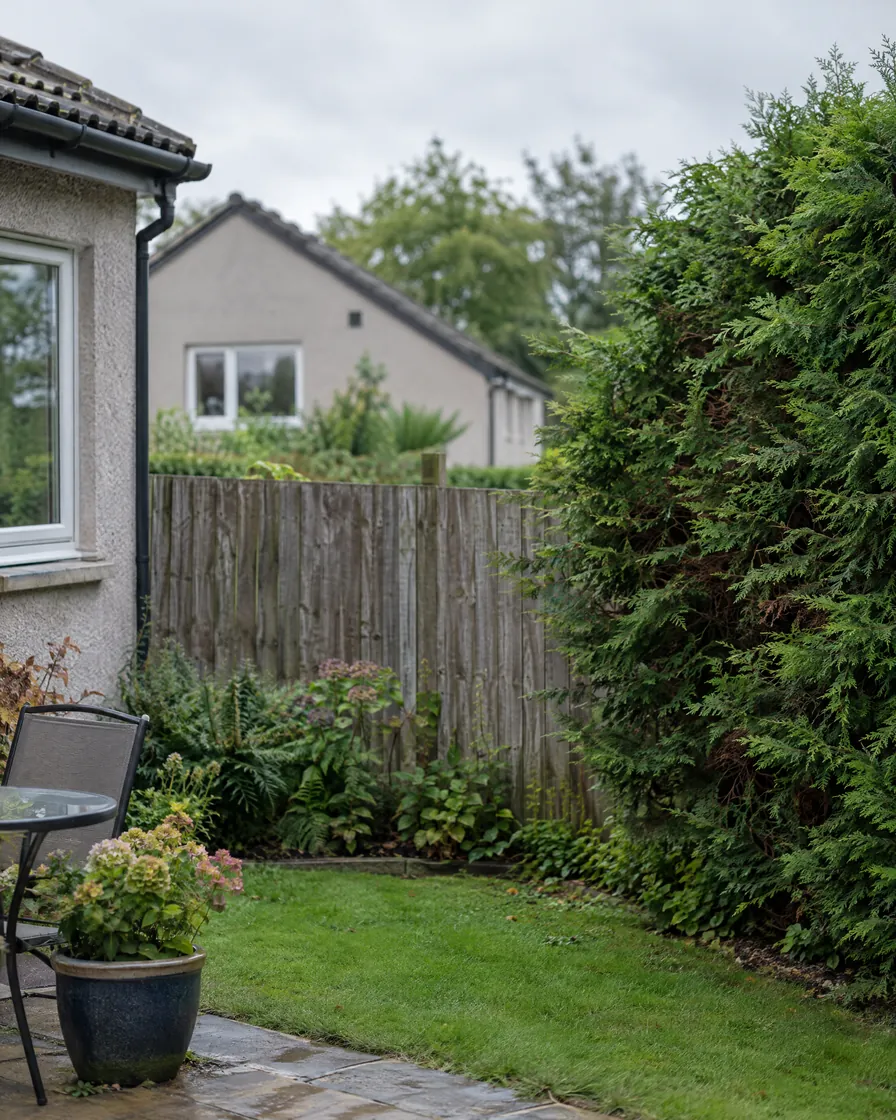
A fence in the wrong place, a blocked path, a hedge that cuts out the light or a neighbour who will not pay their share of a roof repair can quickly take over your life. Property disputes are often about more than money, and the right approach depends on the law, the evidence in the title deeds and the relationship you will have with your neighbour afterwards.
Our property dispute solicitors in Glasgow examine your title, explain your rights and look for a practical solution. Where agreement is not possible, we take the matter to the sheriff court, the Lands Tribunal for Scotland or the local authority, as appropriate.
Key points
- Your title deeds and the plan registered in the Land Register are the starting point in most boundary and access disputes.
- A right of access over someone else's land, called a servitude, can be created in writing or by 20 years of use.
- Applications about high hedges go to your local council, not the court, but only after you have tried to resolve the problem with your neighbour.
- Many disputes can be resolved by a negotiated agreement or a minute of agreement registered against both titles.
Property disputes we deal with
- Boundary disputes: where the true boundary lies, encroachment and fences or walls built in the wrong place.
- Rights of access and servitudes: blocked driveways, paths and shared access roads.
- Title conditions: real burdens restricting how property can be used or altered, and applications to vary or discharge them.
- Tenement and common repairs: roofs, closes and other common parts, and owners who refuse to pay their share.
- Nuisance: noise, water damage, tree roots and other interference from neighbouring property.
- High hedges: hedges that block light to a home.
- Co-owner disputes: where joint owners cannot agree what to do with a property, including actions of division and sale.
Boundary disputes in Scotland
Most properties in Scotland are now registered in the Land Register, where the title plan shows the boundaries based on the Ordnance Survey map. These plans are not always precise enough to settle a dispute on their own, so we also look at older deeds, physical features on the ground and how the land has been used over time. In some cases, possession of land for 10 years on a recorded or registered title can make ownership secure through positive prescription.
If agreement can be reached, a short deed can fix the boundary for the future. If not, the sheriff court can decide where it lies.
Rights of access and title conditions
A servitude is a right to use someone else's land for a particular purpose, such as taking access along a lane. Servitudes can be created in a deed, implied in some situations, or established by open, peaceable use for 20 years. Title conditions, also called real burdens, can restrict what you may do with your own property. The Title Conditions (Scotland) Act 2003 allows owners to apply to the Lands Tribunal for Scotland to vary or discharge burdens that are no longer reasonable.
High hedges
Under the High Hedges (Scotland) Act 2013, if a hedge of two or more trees or shrubs, more than 2 metres high, forms a barrier that significantly reduces light to your home, you can apply to your local council for a high hedge notice. You must first take all reasonable steps to resolve the matter with the owner, and the council charges a fee. We can help you prepare the evidence and the application, or respond if an application is made about your hedge.
Tenement repairs
For flats, the Tenements (Scotland) Act 2004 and your title deeds decide who pays for repairs to common parts and how decisions are made. Where the deeds are silent, the Tenement Management Scheme usually applies, and a majority of owners can make decisions binding on everyone. We advise owners who want to get repairs done and those who are being asked to pay.
How we help
- We examine your title deeds, the Land Register and any plans or photographs.
- We explain your legal position and the realistic options.
- We write to the other party or their solicitor to set out your position.
- We negotiate, or suggest mediation, to reach a lasting agreement.
- If necessary, we raise or defend proceedings in the sheriff court or apply to the Lands Tribunal.
You may also find our guide on resolving a property dispute without going to court helpful. If you are buying or selling, our conveyancing solicitors can check the title for problems before they become disputes.
How we charge
Your first hour with us is free. After that, we explain how our fees are worked out and confirm an estimate in writing before any chargeable work starts. In Scotland the court usually orders the losing party to pay a contribution to the winner's legal costs, called judicial expenses, but this rarely covers the full bill, so we always weigh the likely cost of a step against what it could achieve for you.