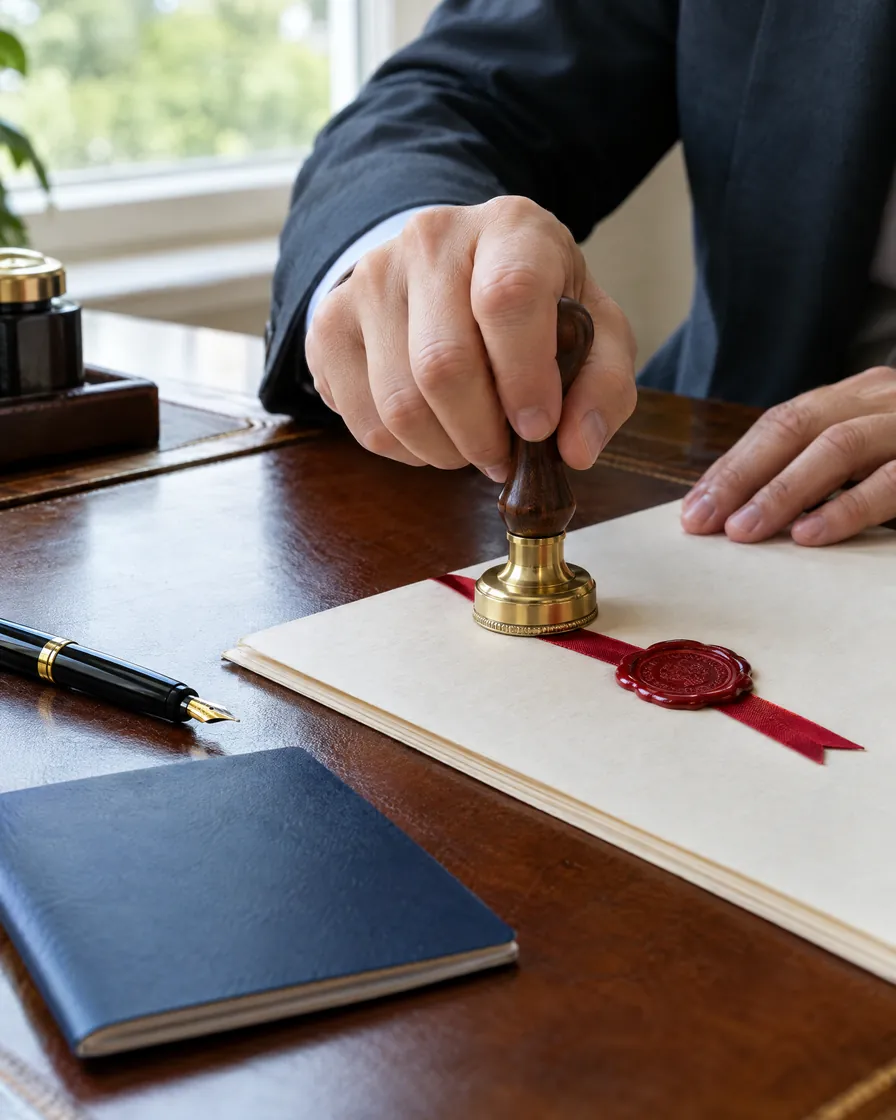
Documents that are used in another country often need to be signed in front of, or certified by, a notary public. A notary is a qualified lawyer authorised to witness signatures, verify documents and certify facts in a way that is recognised internationally. In Scotland, only solicitors who hold a practising certificate can act as notaries, and they are admitted and registered through the Law Society of Scotland.
Stewart Gordon Thomson offers notary public services from our office in Glasgow. Our notary checks your documents and identification, carries out the notarial act and, where needed, arranges for the document to be legalised with an apostille.
Key points
- A notary public in Scotland is a practising solicitor who has also been admitted as a notary.
- Many documents for use abroad need a notarial certificate, an apostille, or both.
- An apostille is issued by the Foreign, Commonwealth and Development Office (FCDO) to confirm that a UK official's signature and seal are genuine.
- Bring your original documents and photographic identification to your appointment.
Documents we notarise
- a power of attorney for use abroad, for example to buy or sell property overseas;
- an affidavit, statutory declaration or other sworn statement;
- certified copies of passports, driving licences and other identity documents;
- certified copies of degree certificates and qualifications;
- birth, marriage and death certificates for use overseas;
- company documents, board resolutions and certificates of incorporation;
- documents for opening a bank account abroad;
- contracts and other legal documents to be signed for use in another country.
We can also administer an oath and take sworn evidence where a document requires it.
Notarisation, legalisation and apostilles
Notarisation is the notary's act, such as witnessing your signature or certifying a copy, recorded in a notarial certificate under their signature and seal. Legalisation is the separate step of confirming that the notary's signature and seal are genuine, so the receiving country will accept the document.
For countries that have signed the Hague Apostille Convention, legalisation is done by attaching an apostille, which is issued in the UK by the FCDO Legalisation Office. The FCDO currently charges £45 per apostille for its standard paper service, plus postage, and £35 for an e-Apostille, with faster services available to registered businesses. Some countries outside the Convention also require the document to be legalised by their embassy or consulate. We tell you what the receiving authority needs and can arrange legalisation for you.
What to bring to your appointment
- the document to be notarised, unsigned if you need to sign it in front of the notary;
- valid photographic identification, such as a passport or photocard driving licence;
- proof of address, such as a recent utility bill or bank statement;
- any instructions you have received from the person or authority asking for the document;
- for company documents, evidence of the company's existence and your authority to sign.
To make an appointment, use the form on this page. If you need a document notarised at short notice, tell us your deadline. Send us the document and any instructions before your appointment if you can. That lets us check exactly what the receiving authority requires, so the appointment achieves what you need first time.
Notary or solicitor certification?
Not every document needs a notary. Some UK organisations accept copies certified by a solicitor, and some government applications have their own rules about who can certify documents. Documents for use abroad, however, usually need a notary. If you are unsure, ask us before you book and we will tell you which you need.
Can documents be notarised remotely?
Remote notarisation is possible for some notarial work, carried out by video, but many receiving countries require you to sign in person in front of the notary, and original documents often need to be inspected. We will confirm what is possible for your document when you get in touch.
Notary fees
Notary fees depend on the number and type of documents and whether legalisation is needed. We confirm the fee in writing before your appointment. FCDO and consular fees are charged at cost in addition to our fee.